

Many people try to boost their immune system with vitamins, supplements, diets, or exercise—but they may not realize that Traditional Chinese Medicine (TCM) offers traditional approaches that may help support general wellness. In TCM, acupuncture and herbal medicine are traditionally described as working on connections between body systems. They may help support overall balance and resilience.
If you're someone who’s often sick, dealing with chronic fatigue, stress, or autoimmune conditions, TCM may help as a complementary option alongside your medical care. It does not treat autoimmune disease itself; keep seeing your doctor and do not change medications without their advice.
How TCM Supports Immunity
The immune system is connected to several body systems:
Lymphatic system: filters pathogens and moves immune cells
Endocrine system: balances hormones like cortisol and adrenaline
Digestive system: produces immune-related hormones and houses the gut microbiome
Nervous system: regulates inflammation via the vagus nerve
Reproductive system: hormonal changes affect immune balance
In TCM theory, treatment is traditionally described as:
Supporting the body's response to stress
Supporting what TCM calls the Lung, Kidney, and Spleen systems
Encouraging relaxation
Promoting circulation of Qi and Blood
Supporting the flow of Qi
Key Immune Organs and Corresponding Acupuncture Points and Herbs
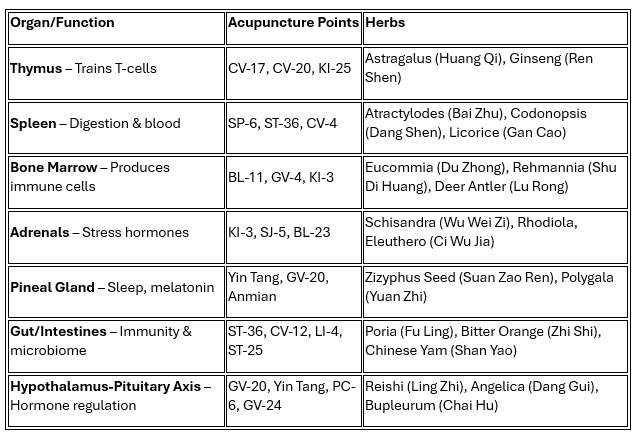
Acupuncture Points Traditionally Used in TCM
ST-36 – Traditionally used to support digestion and energy
CV-17 – Traditionally used to open the chest
GV-20 – Traditionally used to calm the mind
Yin Tang – Traditionally used to calm the mind and aid sleep
KI-3 – Traditionally used to support Kidney energy
SJ-5 – Traditionally used to move Qi
CV-4 – Traditionally used to tonify foundational energy
LU-7 & LI-4 – Traditionally used to support the Lung system
Herbs Traditionally Used in TCM
Astragalus (Huang Qi) – Strengthens Wei Qi (protective energy)
Reishi (Ling Zhi) – Traditionally used in TCM to support wellness
Codonopsis (Dang Shen) – Traditionally used to support stamina and the Lung and Spleen
Schisandra (Wu Wei Zi) – Traditionally used in TCM to support vitality
Licorice Root (Gan Cao) – Traditionally used to harmonize other herbs
Zizyphus Seed (Suan Zao Ren) – Traditionally used for sleep and emotional balance
Atractylodes (Bai Zhu) – Traditionally used to support digestion
These herbs are typically combined into personalized formulas for long-term balance and resilience.
Who Can Benefit from TCM for Immunity?
TCM may help if you experience:
Frequent infections or colds
Chronic fatigue or burnout
Allergies or asthma, alongside your medical care
Support alongside medical care for autoimmune conditions
Digestive imbalances
Poor sleep and stress overload
Skin flare-ups
Long COVID or lingering symptoms
Acupuncture and herbs work best when customized to your body’s constitution and unique patterns.
How TCM Approaches Immune Wellness
Conventional care and TCM each have their place. TCM is traditionally described as supporting the systems behind overall wellness.
Together, acupuncture and herbs may help:
Support stress management
Encourage relaxation
Ease some kinds of discomfort
Support Qi circulation, as TCM describes it
Support restful sleep and better digestion
Patients often report:
More energy
Better sleep
Improved digestion
Feeling more resilient
Calmer mood
Acupuncture + Herbs: A TCM Approach to Wellness
If you’re looking for a personalized approach to wellness, TCM may be an option to discuss.
Acupuncture and herbal medicine are traditionally used to support what TCM describes as balance.
TCM may help you feel supported as part of your overall care.
💬 Frequently Asked Questions (FAQs)
Can acupuncture help with chronic immune issues like fatigue or autoimmune symptoms?
Acupuncture may help with some symptoms such as fatigue as a complementary option. It does not treat autoimmune disease; keep seeing your doctor and do not change medications without their advice.
How often should I get acupuncture for immune support?
Initially 1–2 sessions per week may be recommended, followed by maintenance visits. Your plan will be customized to your condition and goals.
Do TCM herbs interfere with Western medicine?
Some herbs can interact with medications. Your practitioner will ask about your medications, and you should not change any prescribed medication without talking to your doctor.
Is TCM helpful for post-viral recovery or long COVID?
TCM may help with lingering symptoms such as fatigue and brain fog as a complementary option alongside your medical care.
Want to learn more about Immunity and TCM? Check out these blog posts: